
1. Executive Summary & Railway Electrical Environment Overview
Railway power supply architectures operate under some of the most rigorous electrical and environmental conditions found in modern transport engineering. The European Standard EN 50155 (Railway applications — Rolling stock equipment) defines the foundational performance, thermal, electrical, and mechanical parameters required for electronic equipment deployed onboard trains, trams, metro vehicles, and high-speed rail platforms.
At the heart of onboard electronics—ranging from Train Control and Monitoring Systems (TCMS), Passenger Information Systems (PIS), and automatic train control units to cabin HVAC and emergency brake control—is the EN50155 Railway DC DC Converter. These power conversion modules bridge the wide voltage fluctuations of central battery systems (typically nominal voltages of 24V, 36V, 48V, 72V, 96V, or 110V DC) down to tightly regulated low-voltage rails (3.3V, 5V, 12V, 15V, 24V, 48V DC) required by sensitive microprocessors, digital sensors, and communication buses.
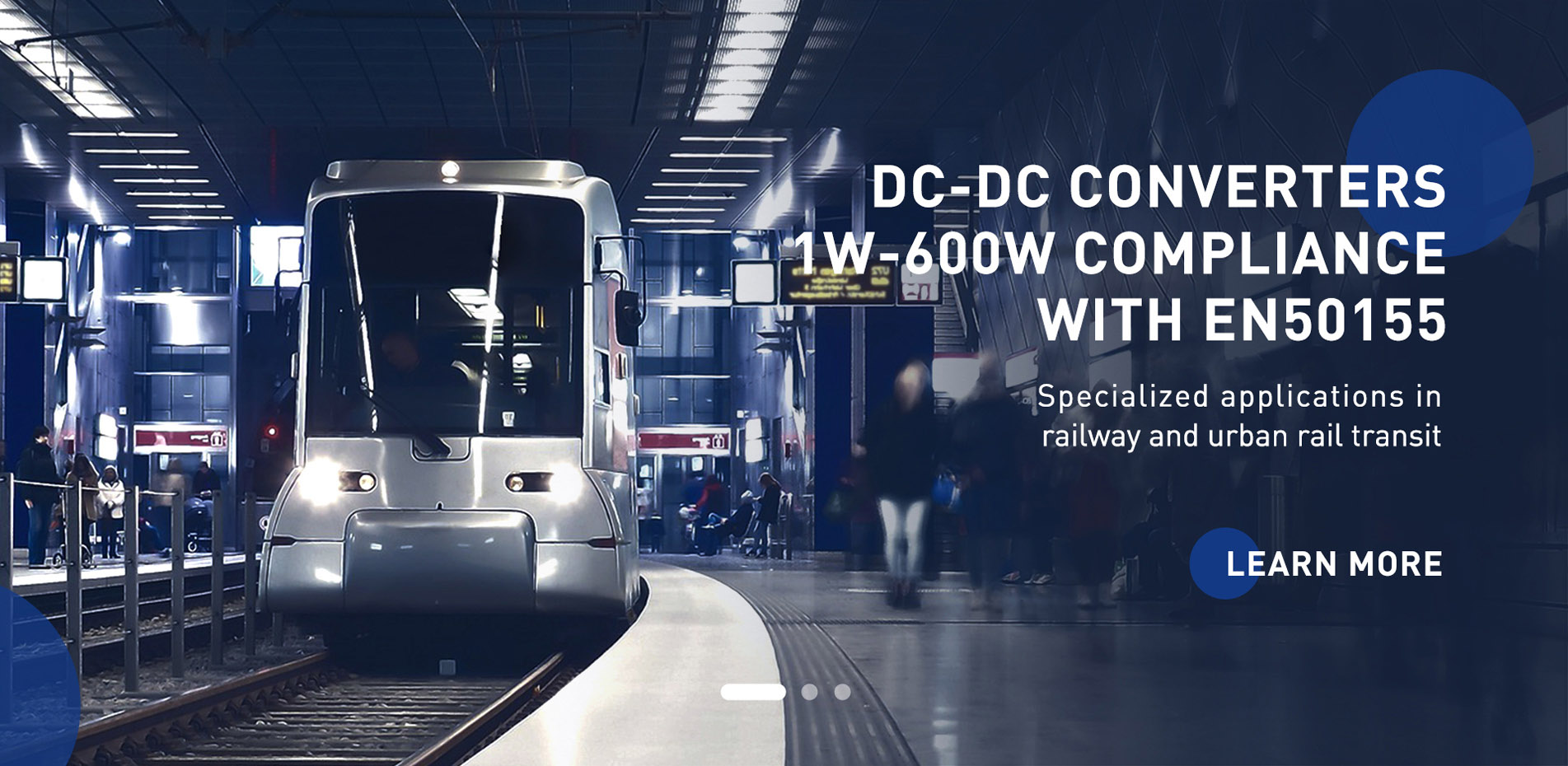
For global procurement managers and system integration engineers, selecting an EN50155 compliant DC/DC converter requires understanding critical operational parameters beyond basic output power and voltage ratings:
- Continuous & Transient Voltage Variations: Continuous operation from 0.7 to 1.25 of nominal supply voltage ($U_n$), with brownout drops down to $0.6 U_n$ (for 100ms) and transient surges up to $1.4 U_n$ (for 1 second).
- Supply Interruptions & Hold-up Time (Class S1, S2, S3): Ensuring continuous system uptime without rebooting during battery switchovers or momentary contact shoe bounce (typically requiring 10ms to 20ms hold-up time).
- Shock & Vibration (EN 61373): Resistance to mechanical shock and random vibration under Category 1 Class A/B body-mount or bogie-mount conditions.
- Extended Operating Temperature Ranges (Classes OT1 to OT6 & Tx): Flawless performance from -40°C start-up to ambient temperatures exceeding +85°C (+105°C PCB baseplate temperature).
2. Critical Technical Standards: EN50155, EN61373, and EN50121-3-2 Explained
When searching for high-performance railway power supplies, system engineers must navigate a complex network of international standards to guarantee interoperability and compliance. Below is an engineering breakdown of how HYGH Technology Co., Ltd. designs converters to meet and exceed these specifications:
| Standard Code | Standard Scope | Core Requirement Parameters | HYGH Engineering Solution |
|---|---|---|---|
| EN 50155 | Railway Rolling Stock Equipment | Input range ($0.7–1.25 U_n$), brownout transients ($0.6 U_n$), hold-up time ($10-20\text{ms}$), isolation, moisture & thermal stress. | Ultra-wide 4:1 and 12:1 input modules with built-in active hold-up logic and 2250VDC–3000VAC reinforced isolation barriers. |
| EN 61373 | Shock & Vibration Testing | Random vibration testing (5Hz to 150Hz), long-life testing, and simulated 5g/30g mechanical shock pulses. | Robotic potted encapsulation (silicone/epoxy thermosetting resin), heavy-duty mechanical pinning, and ruggedized DIP/Brick enclosures. |
| EN 50121-3-2 | Electromagnetic Compatibility (EMC) | Conducted emissions (EN 55011/32), radiated noise, electrostatic discharge (ESD EN 61000-4-2), fast transient bursts (EFT EN 61000-4-4). | Integrated multi-stage LC filters, internal shield cans, and compatible external surge protection modules (SSPC). |
| EN 45545-2 | Fire Safety on Railway Vehicles | Material toxicity, smoke density, and flame spread prevention (Hazard Level HL1 to HL3). | UL94 V-0 flame-retardant encapsulation materials and halogen-free PCB substrate assemblies. |
Input Voltage Specifications: Nominal vs. Extreme Operating Ranges
The standard EN 50155:2017 outlines fixed nominal voltages used across international rail networks. Because regional trains, metro networks, and diesel-electric locomotives utilize different auxiliary battery voltages, procurement teams traditionally faced significant stock keeping unit (SKU) proliferation. HYGH Technology Co., Ltd. solves this through ultra-wide input ratio topologies (4:1 and 12:1).
Consider the voltage spectrum mandatory for compliance across standard nominal rails:
- 24V Nominal Battery: Continuous range 16.8V to 30V DC (Surge transient: 14.4V to 33.6V DC).
- 48V Nominal Battery: Continuous range 33.6V to 60V DC (Surge transient: 28.8V to 67.2V DC).
- 72V Nominal Battery: Continuous range 50.4V to 90V DC (Surge transient: 43.2V to 100.8V DC).
- 110V Nominal Battery: Continuous range 77V to 137.5V DC (Surge transient: 66V to 154V DC).
HYGH Technology's 14V to 160V DC (12:1 Ratio) single-module solutions cover all the above nominal inputs within one universal unit, drastically simplifying inventory management, engineering qualification, and global maintenance logistics for rolling stock manufacturers.
3. HYGH Technology Co., Ltd. EN50155 Railway DC DC Converter Product Portfolio
HYGH Technology Co., Ltd. engineers a comprehensive range of board-mount, DIP-isolated, and industry-standard brick DC/DC converters specifically designed for harsh rail transit applications. Below are our key product categories recommended for OEM integrators:

1×1 & 1×2 DIP Isolated Series (5W–50W)
Compact PCB mount converters featuring 4:1 wide input, 2250VDC isolation, and operational efficiency up to 90%. Perfect for onboard sensor arrays, signal control boards, and communication nodes.
Send an Inquiry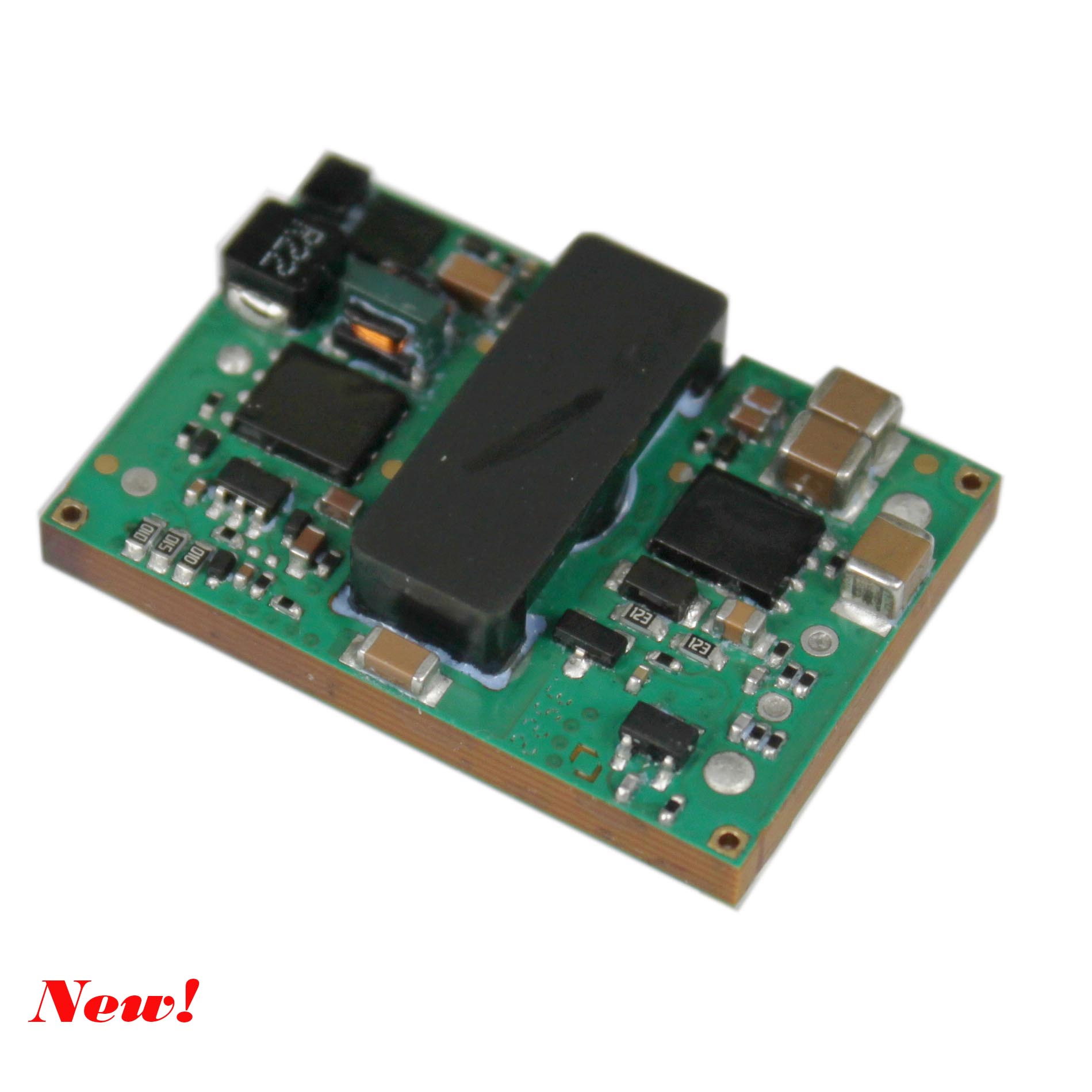
Brick Isolated Series (50W–300W)
Industry-standard Eighth-Brick, Quarter-Brick, and Half-Brick packages. High power density up to 93% efficiency, baseplate cooling, and compliance with EN50155 / EN61373 rail standards.
Send an Inquiry
DC EMI Filters & Surge Protectors (SSPC)
Front-end surge suppression and EMI filter modules designed to absorb high-energy catenary voltage spikes and fulfill EN50121-3-2 EMC Class B emission requirements.
Send an InquiryDetailed Technical Specification Matrix: Featured Railway Converters
For detailed engineering evaluations, the table below illustrates representative technical specifications across HYGH Technology's flagship railway converter lines:
| Series Model | Form Factor / Package | Input Voltage Range | Output Power | Isolation Voltage | Operating Temp. | Key Applications |
|---|---|---|---|---|---|---|
| WSD50-100W | Sixteenth-Brick / DIP | 18V – 75V DC (4:1) | 50W – 100W | 2250 VDC | -40°C to +105°C | TCMS, Cab Radios, Door Controls |
| ZDQ400W | Quarter-Brick Baseplate | 16V – 40V / 66V – 160V | 300W – 400W | 3000 VAC | -40°C to +100°C | PIS Displays, CCTV Storage Servers |
| YEO240W-R | Eighth-Brick Ultra-Dense | 36V – 75V DC | 240W | 2250 VDC | -40°C to +85°C | High-Density Telecom & Ethernet Switches |
| RWB600W | Half-Brick Metal Case | 14V – 160V DC (12:1) | 500W – 600W | 3000 VAC | -40°C to +105°C | Auxiliary HVAC Controls, Traction Control |
4. Future Technological & Procurement Trends in Railway Power Electronics
As global urban rail transit networks modernize and high-speed rail systems expand, procurement teams and electrical system architects face evolving technological demands. Recognizing these shifts allows OEM engineers to future-proof their train system architectures.
Trend 1: Migration Toward Universal 12:1 Ultra-Wide Input Voltage Ratios
Historically, power supply manufacturers designed dedicated converters for 24V, 48V, or 110V railway lines. However, modern rolling stock platforms are designed for international deployment across varied regional power grids. Universal input converters (14V to 160V DC continuous) allow train builders to standardize on a single power module design across all vehicle variants. This trend reduces qualification overhead, minimizes component failure modes, and streamlines spare parts management throughout a 30-year locomotive lifecycle.
Trend 2: Wide Bandgap (GaN / SiC) Semiconductors & High Power Density
Space constraints inside train control cabinets have become tighter as automated train operation (ATO) and passenger infotainment demands more processing electronics. The integration of Silicon Carbide (SiC) and Gallium Nitride (GaN) switching components enables switching frequencies above 300kHz–500kHz. This drastically reduces the size of passive magnetic components (transformers and inductors), yielding power densities exceeding 16W/cm³ while elevating conversion efficiencies above 93%. Higher efficiency directly correlates to lower thermal dissipation inside sealed IP67 enclosures.
Trend 3: Digital Telemetry, PMBus, and Predictive Maintenance Integration
Under the Industry 4.0 paradigm, modern railway operators require real-time health monitoring of critical sub-systems. Advanced EN50155 converters are increasingly equipped with digital PMBus or CANbus interfaces. These protocols deliver real-time telemetry metrics—such as input/output voltage status, load currents, baseplate temperature trends, and ripple anomalies—enabling central maintenance servers to predict power supply degradation prior to catastrophic field failure.
Trend 4: Enhanced Environmental Stress Screening (ESS) & Extended Lifecycles
Railway contracts routinely demand product availability and support guarantees spanning 15 to 30 years. Modern procurement guidelines prioritize power module suppliers that provide full Component Change Notifications (CCN), end-of-life (EOL) protection, and rigorous burn-in screening. Vacuum potting, 100% full-load thermal cycling (-40°C to +85°C), and automated optical inspection (AOI) are now baseline requirements for tier-1 rail suppliers.
5. Corporate Competence & E-E-A-T Capabilities: HYGH Technology Co., Ltd.
With over 17 years of experience since our founding in 2007, HYGH Technology Co., Ltd. stands as a premier manufacturer of industrial AC/DC power supplies, isolated DC/DC converters, EN50155 railway power modules, medical power supplies, and EMI filters. Our engineering operations prioritize Experience, Expertise, Authoritativeness, and Trustworthiness (E-E-A-T) across all manufacturing processes.
Why Global OEM Procurement Teams Choose HYGH Technology Co., Ltd.
Our commitment to engineering excellence ensures your rail transit systems achieve unmatched operational reliability and regulatory compliance.
17+ Years Power Design Expertise
Established in 2007, our dedicated R&D teams specialize in high-voltage isolation, planar transformer magnetics, and harsh environment power conversion topologies.
Comprehensive Certification Assurance
All railway power products undergo rigorous testing to guarantee full compliance with CE, EN50155, EN61373, EN50121-3-2, and UL94 V-0 standards.
State-of-the-Art SMT & Potting Production
Utilizing high-speed Yamaha SMT lines, automated silicone/epoxy potting systems, and computer-controlled 100% full-load burn-in testing chambers.
Global Distribution & OEM Customization
Trusted by industrial OEM engineers across 50+ countries in Europe, North America, Asia, and the Middle East with custom modified-standard solutions.
Request Technical Datasheets or Custom Railway Power Quotes
Speak directly with our senior application engineers to review your voltage requirements, thermal constraints, and compliance documentation.
Send an Inquiry